


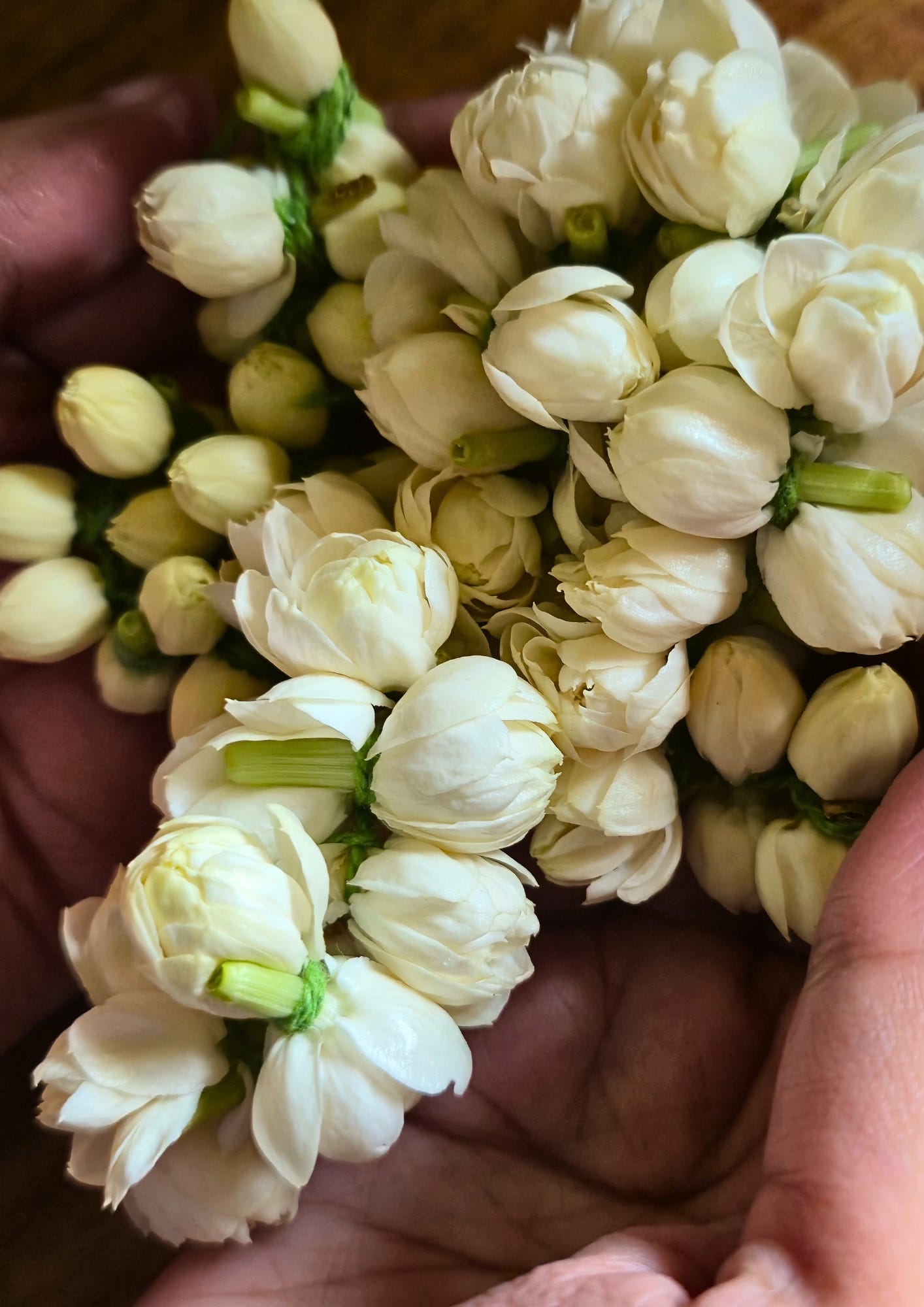
Once you smell the real flower or the true absolute, you will instantly understand why botanical perfume is worth engaging with. Its lush, sweet, floral, indolic, exotic, heady scent is one of the most beloved, and not only by women. Jasmine is often pushed into stereotyped scents, while its character can be used much more efficiently in botanical perfumery, not necessarily in large amounts, which is also useful for more budget-conscious compositions. Extending its note is one of the fundamental skills you need as a perfumer.
Notes: For this post, jasmine absolute was kindly provided by Robertet and tested by me for quality.
Before we explore its use in natural perfumery, let’s look at some of the most fascinating facts about jasmine:
Jasmine flowers are usually harvested before sunrise, often between 2–6 a.m., because the scent molecules are strongest at night and begin fading quickly after sunrise.
True jasmine essential oil is almost never steam-distilled for fine perfumery. The delicate flowers are too fragile, so jasmine is traditionally extracted as an absolute using solvent extraction.
It can take around 7–8 million jasmine flowers to produce just 1 kg of jasmine absolute. Each flower is picked individually by hand.