


The formulas offer a gentle introduction to basic natural perfumery, allowing you to learn through hands-on experience with blending, adjusting, and exploring aromatic materials. Each formula is intentionally minimal, featuring natural aromatics that are easy to work with and can be adapted to suit your needs.
Some ingredients may have maximum dermal limits; please check each material individually in Essential Oil Safety by Robert Tisserand and Rodney Young (2014).
The blends are unisex, focusing on the intrinsic beauty of the materials rather than conforming to traditional fragrance categories. You are encouraged to adapt them freely according to your personal preferences, mood, or creative direction.
The following formula is best suited to intermediate-level students with prior experience handling precious, rare, or highly viscous aromatic materials. It assumes familiarity with correct dilution practices, the careful blending of potent absolutes, and the precise handling of high-value ingredients. This exercise offers an opportunity to deepen your understanding of complex accords, refine sensory evaluation skills, and explore the emotional and olfactory layering that rare botanicals can bring to a composition.
Notes: Some of the materials (*) were kindly provided by Robertet and tested by me for quality.
Building Tea-Inspired Compositions
Tea-inspired blends are among the most difficult to build, not only in botanical perfumery. The scent of tea tends to be very subtle and fleeting, often leaning slightly feminine, though not always. Composing a formula that captures these qualities while lasting long enough to enjoy is not easy. You can either keep the dosage low, closer to an Eau de Toilette or Eau de Cologne, to emphasise its nature, or, as I prefer, approach it from your own creative perspective.
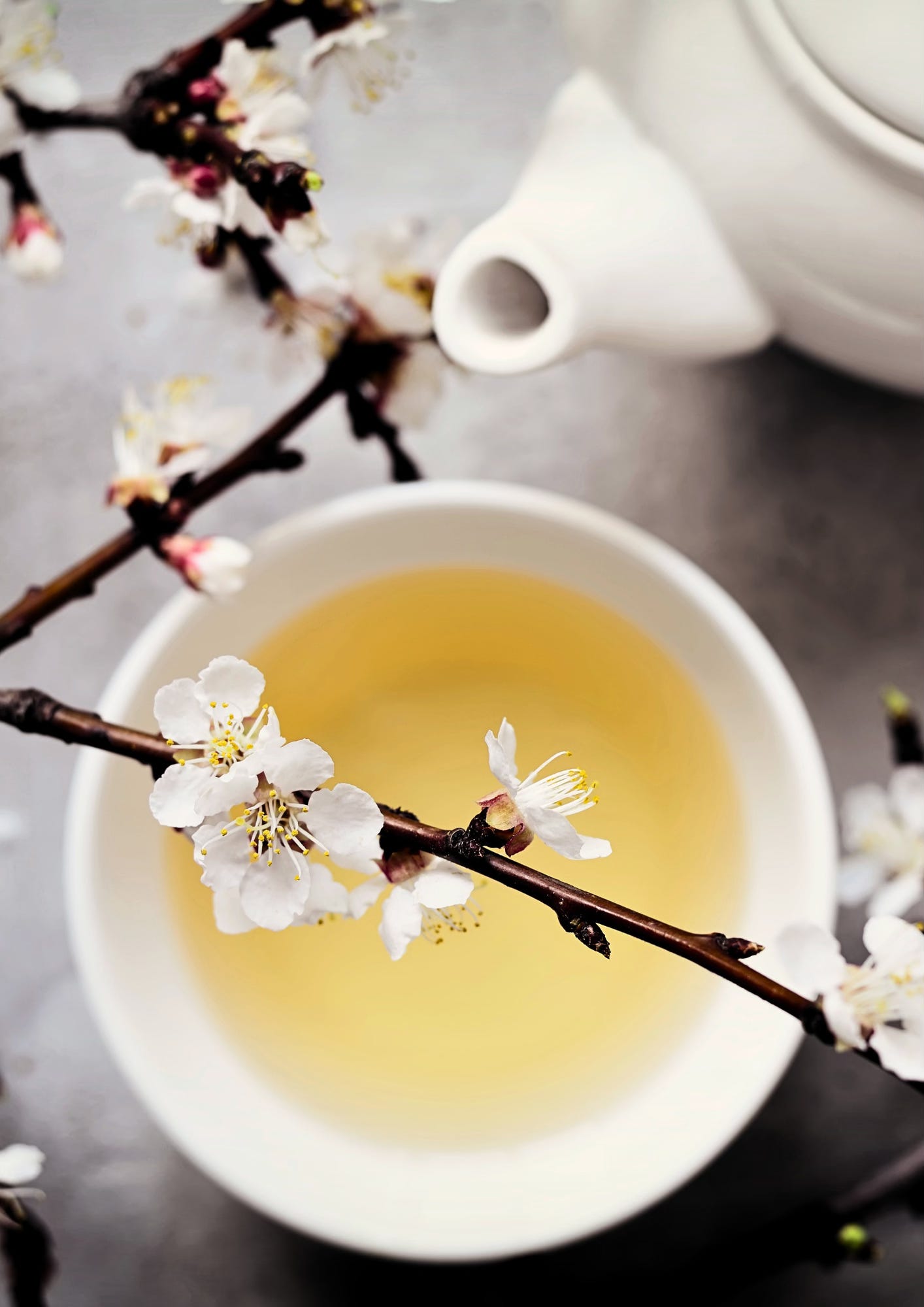
White tea is one of the least processed types of tea, made from young leaves and buds that are simply withered and dried. The infusion is pale in colour and light in body, with a gentle, slightly sweet taste and minimal bitterness. Compared to green or black tea, white tea retains a more natural character of the leaf, offering a calm, refreshing drinking experience that is often associated with purity and simplicity.
Some materials are already intuitively and intrinsically associated with tea notes, such as Bergamot and Jasmine, but the world of natural aromatics is much more complex than that. I have gathered 22 aromatics that you can mix and match to create a white tea inspired natural perfume, depending on your olfactory preferences.
White tea, if you have ever smelled the raw leaves, has a soft, slightly dry, powdery, and delicate profile. Here, it serves as inspiration. We are not imitating it, but reinterpreting and reimagining it to create something truly artistic. Use the formula to build an accord of white tea or a complete blend. The idea is to create a light, airy, tea-like note, and perhaps even evoke an emotion, a character, or a moment.